

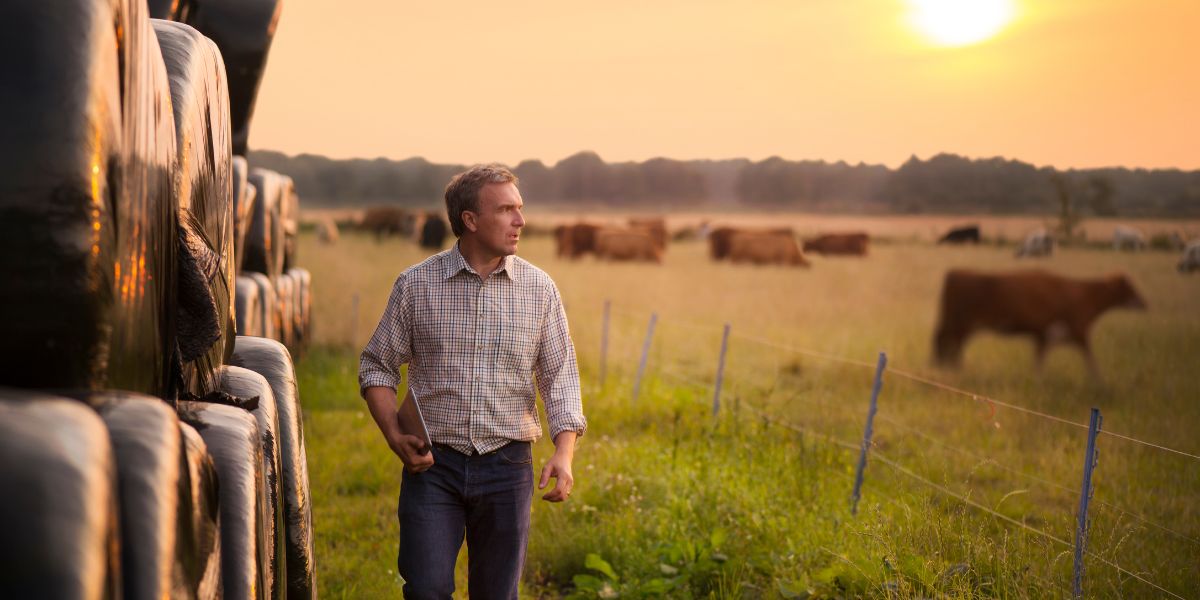
The circular economy is a concept that has been gaining more and more space in discussions about sustainability and productive efficiency. In the field of livestock, the application of the principles of circular economy can bring numerous benefits, both in environmental and economic terms. This article aims to explore the concepts of circular economy and its application in livestock, highlighting the main challenges and opportunities.
What is circular economy?
The circular economy is an economic model that seeks to minimize waste and maximize the use of resources. Unlike the traditional linear economy, which follows the flow “extract-produce-discard”, the circular economy proposes a closed cycle, in which waste is transformed into new resources. Thus, the goal is to reduce the extraction of virgin raw materials and waste disposal, promoting reuse, repair, remanufacturing and recycling.
Circular economy in livestock
Livestock farming is an activity that can benefit significantly from the application of circular economy principles.Some of the main areas in which the circular economy can be applied in livestock include:
- Waste utilization
One of the main aspects of the circular economy in livestock is the use of waste generated by the activity. These residues, such as manure, animal carcasses and food scraps, can be transformed into new resources, such as organic fertilizers, biogas and animal feed.
Manure, for example, can be used as a natural fertilizer for forage production, reducing the need for chemical fertilizers and improving soil quality.In addition, manure can be used for the production of biogas, a renewable energy source that can be used on the farm itself or sold to the power grid.
- Integration between agriculture and livestock
Another important aspect of the circular economy in livestock is the integration between agriculture and livestock. This integration allows the use of waste from one activity as input to another, closing the production cycle.
For example, crop residues can be used as feed for animals, reducing the need for commercial feed and taking advantage of a resource that would be discarded. Similarly, animal manure can be used as fertilizer for agricultural crops, reducing the need for chemical fertilizers.
- Animal welfare and productive efficiency
The circular economy in livestock farming can also contribute to animal welfare and productive efficiency.By promoting the use of waste and the integration between agriculture and livestock, it is possible to reduce production costs and improve the quality of life of animals.
For example, the use of compost beds for cattle can improve animal comfort and health while transforming waste into organic fertilizer.In addition, the production of feed on the farm itself using agricultural waste can reduce feed costs and improve feed quality.
Challenges and opportunities
Despite the benefits of the circular economy in livestock, there are also challenges to be faced. One of the main challenges is the need for investments in technologies and infrastructure for the use of waste and the integration between agriculture and livestock.
Another challenge is the change of mentality of producers and consumers, who are often accustomed to the traditional linear model. It is necessary to raise awareness and education so that the circular economy is seen as an opportunity and not as a threat.
However, there are also many opportunities for the application of circular economy in livestock.With the growing concern for sustainability and productive efficiency, the circular economy can become a competitive differentiator for producers who adopt this model.
In addition, the circular economy can contribute to reducing the environmental impacts of livestock, such as the emission of greenhouse gases and water and soil pollution.By promoting the use of waste and the integration between agriculture and livestock, it is possible to reduce the pressure on natural resources and contribute to the preservation of the environment.
Conclusion
The circular economy in livestock is a concept that can bring numerous benefits, both in environmental and economic terms.By promoting the use of waste, the integration between agriculture and livestock and animal welfare, it is possible to increase production efficiency and reduce the environmental impacts of the activity.
However, for the circular economy to be effectively applied in livestock, it is necessary to overcome some challenges, such as the need for investments in technologies and infrastructure and the change of mentality of producers and consumers.
Despite the challenges, the opportunities of the circular economy in livestock are many. With the growing concern for sustainability and productive efficiency, the adoption of this model can become a competitive differential for producers and contribute to the preservation of the environment.
Therefore, it is essential that the circular economy is increasingly discussed and applied in livestock, as a way to promote a more sustainable, efficient and responsible activity.



