

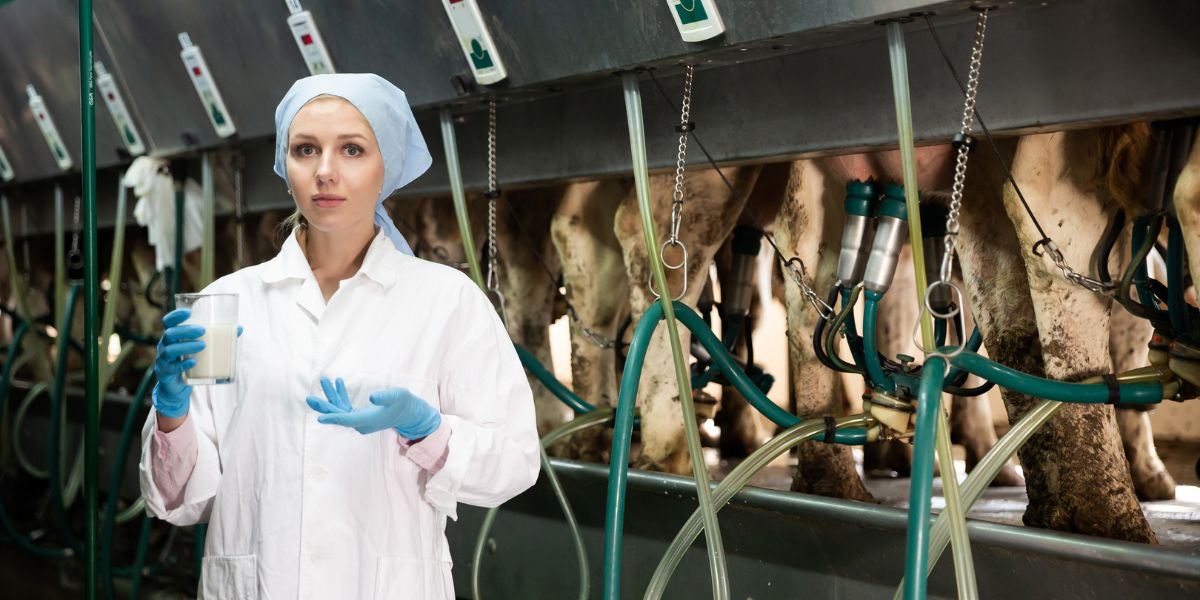
Technological advances in agriculture have allowed dairy farmers to achieve optimized production levels. One of the main tools used for this is genetic improvement.In this article, we will explore how genetic improvement has been employed in milk production and understand its advantages and disadvantages.
What is genetic improvement?
Genetic breeding is the process of selecting animals with the desired characteristics for reproduction in order to obtain offspring that also possess these characteristics. This process can be carried out in several ways, such as through natural selection (choosing the animals that survive and reproduce more easily), artificial selection (choosing the animals by man) or genetic engineering (modification of the characteristics of animals through DNA manipulation).
Genetic breeding is important for agriculture, as it allows to increase productivity and food quality. It also contributes to animal welfare, since the selected animals are more resistant to diseases and adverse conditions.In addition, genetic improvement can be used to conserve endangered species.
Why genetic improvement?
Dairy cattle is important for the Brazilian economy, representing about 25% of milk production in the country. Improving milk quality and animal productivity is a constant goal of the milk industry.Genetic improvement can help achieve this goal, as it allows the control of animal characteristics.
Brazilian dairy cattle have some desirable characteristics, such as good milk production and adaptability to the tropical climate. However, there is still much room for improvement.The use of genetic improvement techniques can allow breeders to select animals with the desired characteristics, such as greater resistance to disease and higher productivity.
In addition, genetic improvement can help preserve local dairy breeds, which may have been raised by family farmers.These breeds may have genetic characteristics that are not present in other breeds, such as increased disease resistance or resistance to heat stress.Genetic breeding allows these traits to be preserved and improved, allowing genetic diversification of Brazilian dairy herds.
Genetic improvement techniques
Dairy cattle is one of the main breeds of cattle in Brazil. Although the country is the third largest producer of milk in the world, domestic production is still lower than in Europe and Latin America.To increase the productivity of dairy cattle, farmers have invested in genetic improvements in recent decades.
The most used genetic improvement techniques are artificial selection and Fixed-Time Artificial Insemination (IATF). Artificial selection is a process in which animals with the characteristics desired by breeders are chosen for reproduction. The IATF is a technique that allows to control the moment of ovulation of females, facilitating insemination with semen of selected bulls.
In addition to these two techniques, other genetic improvement tools, such as the use of molecular markers, are also being used for the improvement of dairy cattle. This technology allows breeders to quickly identify the desired characteristics in animals and select those with the highest productive potential.
Another genetic improvement tool that has been widely used is the introduction of new breeds and crosses between them. This technique allows to obtain animals with higher milk quality and more productive characteristics. Finally, breeders also use balanced feeding to ensure the good development of captive animals.
Genetic improvement in Brazil
The genetic improvement of dairy cattle has been one of the main priorities of the dairy sector in Brazil in recent years.The demand for milk and dairy products has grown significantly in the country, which has led to the need to increase the productivity of the herds.
To meet this demand, several initiatives were developed by the Ministry of Agriculture, Livestock and Supply (MAPA), with the aim of improving the genetic quality of Brazilian dairy cattle.These initiatives include the National Program for Bovine Genetic Improvement (PNMGB) and the Brazilian Program for Genetic Quality (PBQG).
The PNMGB aims to increase the productivity of herds by improving the genetic quality of cattle. Already the PBQG is a program aimed at the selection and standardization of animals used in breeding programs.
Through these programs, it has already been possible to achieve an increase in milk production and improvements in the herd. MAPA has also invested in research to develop new technologies and techniques of genetic improvement, which contribute to the growth of the Brazilian dairy sector.
Advantages and disadvantages of genetic improvement
Genetic breeding is a process by which the best animals are selected for breeding in order to improve the desired characteristics of the population.
The advantages of genetic improvement are:
Increase productivity;
Improving milk quality;
Reduction of diseases in animals;
increase longevity of animals.
Disadvantages:
high costs with the acquisition of the animals selected for breeding;
''Risks of genetically modifying animals in an unwanted way;
Necessity to control the environment and the conditions in which animals live to avoid health problems.
Conclusion
Dairy cattle have undergone genetic improvements over the years, which has resulted in healthier and better quality milk. Despite advances, there is still much to be done for all animals to be used to the fullest and produce high quality milk.



