

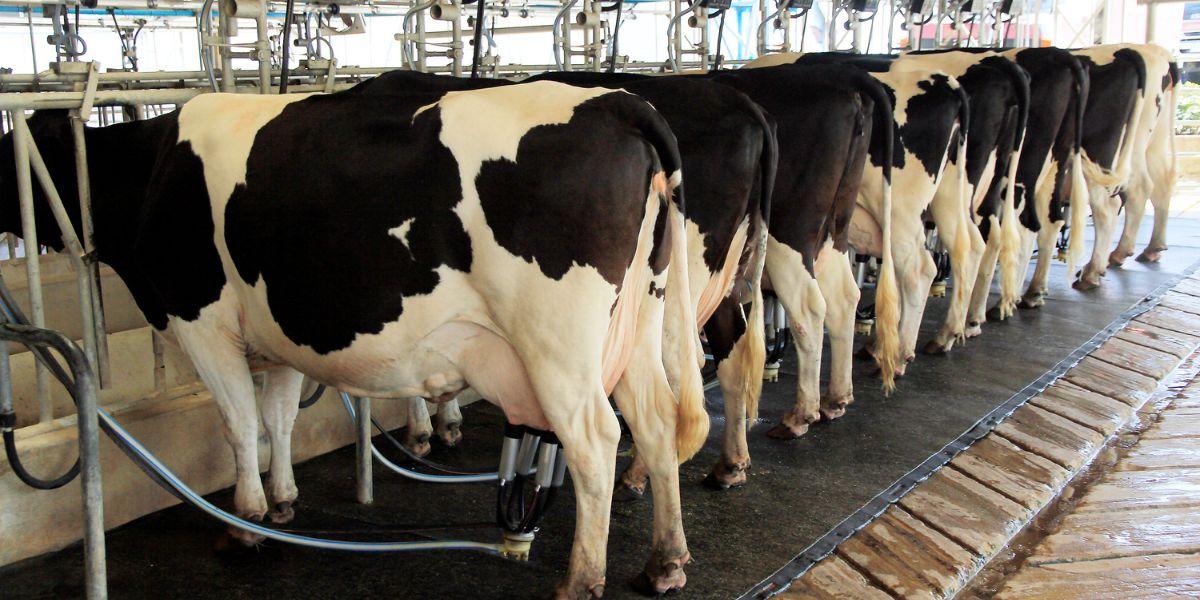
The study of Embrapa Livestock Southeast (SP) revealed that for production of zero carbon milk, intensive systems require, on average, 52 trees per cow. The planting of trees is a way to offset greenhouse gas emissions (GHGs), enabling livestock to become more sustainable and return to decarbonization. Already the extensive system (low technological level) needs 33 eucalyptus to achieve this result.
A study published in Frontiers in Veterinary Science evaluated the ability of Dutch Black and White cows (HPB) and jerolandas to reduce greenhouse gas (GHG) emissions, depending on intensification levels. Continuous grazing with low stocking rate and rotated irrigated with high stocking rate were considered, as well as the interactions between these factors.
To understand the impact of greenhouse gas emissions, a study was conducted to calculate the carbon balance.This included the amount of methane produced and the amount stored in the soil. Based on these data, it was possible to determine the necessary number of trees to mitigate the negative effects of these gases, as well as the advantages of carbon sequestration.
The Brazilian productive production was compared with two pasture strategies: extensive and intensive.In addition, two bovine breeds, HPB and Jersolanda, which are traditionally used for milk production in Brazil, were targeted.
If compared exclusively by breeds, jerolandas are more efficient with regard to gas emissions. To compensate for planting 38 trees per cow, the owner needs to have 8 more trees when opting for the Dutch breed.
Researcher Patricia P. A. Oliveira found that Brazilian livestock depends mainly on pastures. This gives it a benefit to reduce greenhouse gas emissions and environmental footprint, as it is necessary to plant fewer trees to compensate for GHGs. Pasture-raised cattle also contribute positively to the carbon balance, as they sequester soil carbon, offsetting the emissions produced by the system.
Brazil is the third largest producer of milk in the world, with an annual production of 35 billion liters. Many agricultural properties in the country, usually small and medium, are spread in almost 100% of Brazilian municipalities, generating employment for more than 4 million people. However, the average productivity per cow is severely below the world average 4 liters per day versus 10 liters per day, respectively “this discrepant scenario of low systematic efficiency can be explained by the production model adopted. Grasses are the main source of food for dairy farmers in systems based on compromised quality pastures, which are often a population of low efficiency.
Lately, consumers have been concerned about product quality as well as sustainability and animal welfare issues.This demand has made it necessary for the industry to raise its productivity.
Worldwide, there is a great concern about climate change.In Brazil, agriculture is responsible for 33.6% of Brazilian emissions of Greenhouse Gases (GHG), 19% of which come from enteric fermentation. One of the main contributors to this index is the cattle herd, which emits 97% of methane in the environment; 86% of the beef herd and 11% of dairy cattle.
“Strategies to reduce greenhouse gas emissions, such as changes in the management of pasture milk production systems, through the intensification of the use of forage and the use of more specialized breeds and animal crosses, can contribute to offset GHG emissions. Compared to traditional dairy systems are carbon sinks. These actions 'improve soil fertility and pasture management, nutrition and animal genetics are basic and easily adopted points 'can contribute to the carbon balance of dairy farms and reduce the need for other external procedures, such as the purchase of carbon credits to offset the” emissions, emphasizes the researcher.
Sustainable intensification of dairy farming production systems can become a key technology for climate change mitigation.“Long-term experiments results in this area are important for tropical and subtropical regions and need to be carried out, even though they are quite costly and laborious”, he adds.



